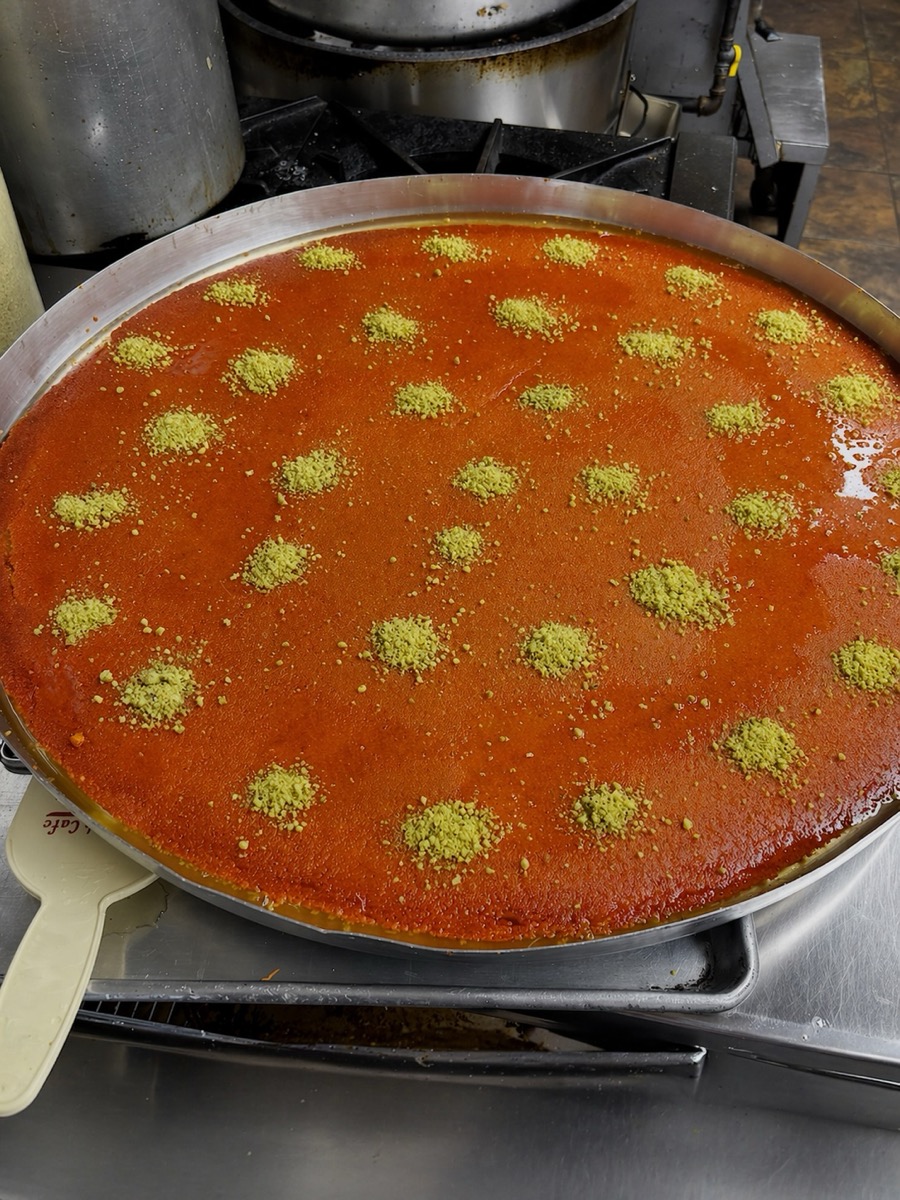
Knafeh is a warm Middle Eastern dessert: mild, stretchy white cheese baked under a layer of buttery pastry, soaked in sugar syrup and finished with ground pistachios. The best-known version, Knafeh Nabulsieh, comes from the Palestinian city of Nablus.
How do you say it, and how do you spell it?
In Arabic it is written كنافة. Most English speakers say kuh-NAH-feh.
Because the word is transliterated from Arabic, you will see many spellings for the same dessert: knafeh, kunafa, kanafeh, kunafeh, knafe, and künefe in Turkish. "Kunafa" is the spelling heard most in Egypt and the Gulf; "knafeh" is common in Palestine, Jordan, Lebanon and Syria.
What does knafeh taste like?
Sweet, buttery and a little salty at the same time. The cheese is mild and milky rather than sharp, and it stretches when the knafeh is hot. The pastry is crisp or tender depending on the style, and the syrup, often scented with orange blossom or rose water, soaks in while everything is still warm. Pistachios add a nutty finish.
If you like the mix of sweet and salty in a cheese danish or a cheesecake, you will probably like knafeh.
What is knafeh made of?
- Cheese. Traditionally Nabulsi cheese, a white brined cheese from Nablus that is soaked to remove most of its salt. Outside the region, bakers often use akkawi or blends that melt the same way.
- Pastry. Either fine, semolina-like crumbs or long, thin shredded strands of dough, often sold as kataifi.
- Butter or ghee, which crisps the pastry. Nablus-style knafeh gets its orange tint from a coloring added with it.
- Sugar syrup, called attar or qatr, poured over while the knafeh is hot.
- Ground pistachios on top.
At Knafeh Cafe we make our knafeh dough in-house.
Soft or crispy? The two main styles
Knafeh na'ameh means "fine" or soft. The dough is ground into fine crumbs and pressed into a smooth, tender crust. This is the style most people picture when they hear Knafeh Nabulsieh.
Knafeh khishneh means "rough" or crispy. It is made with long shredded strands of dough that bake into a crunchy, golden layer around the cheese.
We make both soft and crispy knafeh. You can see what is available on our knafeh menu.
Where does knafeh come from?
Knafeh is most closely tied to Nablus, a city in the West Bank in Palestine known for its cheese and its sweet makers. "Nabulsieh" simply means "from Nablus."
Related desserts are made across the eastern Mediterranean: in Jordan, Lebanon, Syria and Egypt, and in Turkey, where a version called künefe is associated with the Hatay region. So is knafeh Palestinian or Turkish? Knafeh Nabulsieh is Palestinian; künefe is its Turkish relative. Both belong to the same family of cheese-and-pastry sweets.
Its exact origins are debated. Popular stories trace it to the kitchens of medieval caliphs, but those accounts are hard to verify. What is certain is that knafeh has been part of everyday life and celebrations in the Levant for generations.
When do people eat it?
Warm, soon after it comes out of the pan. In the Levant it is a morning or afternoon treat with coffee or tea as well as a dessert after a meal, and it is a fixture at weddings, graduations, holidays and family gatherings. That is why knafeh is so often made in large trays and cut to share.
Is knafeh healthy?
It is a dessert made of cheese, butter, pastry and syrup. Like baklava or cheesecake, it is best enjoyed as a treat, and a slice is easy to share.
Traditional knafeh contains milk, wheat and tree nuts (pistachios). If you have a food allergy or a dietary restriction, call us at (714) 442-0044 before you order.
Knafeh beyond the classic
Bakers also play with the format. On our menu you will find Dubai knafeh layered with pistachio sauce, plus Nutella, Biscoff, walnut and pistachio versions, alongside classic Knafeh Nabulsieh by the slice, as a personal knafeh, or by the tray.
Where can I try knafeh?
If you are in Southern California, visit us at 866 S Brookhurst St in Anaheim's Little Arabia. We are about 3.5 miles from the Disneyland Resort and about 25 miles from downtown Los Angeles, and we are open every day from 12 pm to 9 pm.
You can order online for pickup (opens in a new tab), and we sell frozen knafeh trays and knafeh dough to make at home; both are on the menu. For weddings and events across Southern California, we bring a live knafeh station to you.